
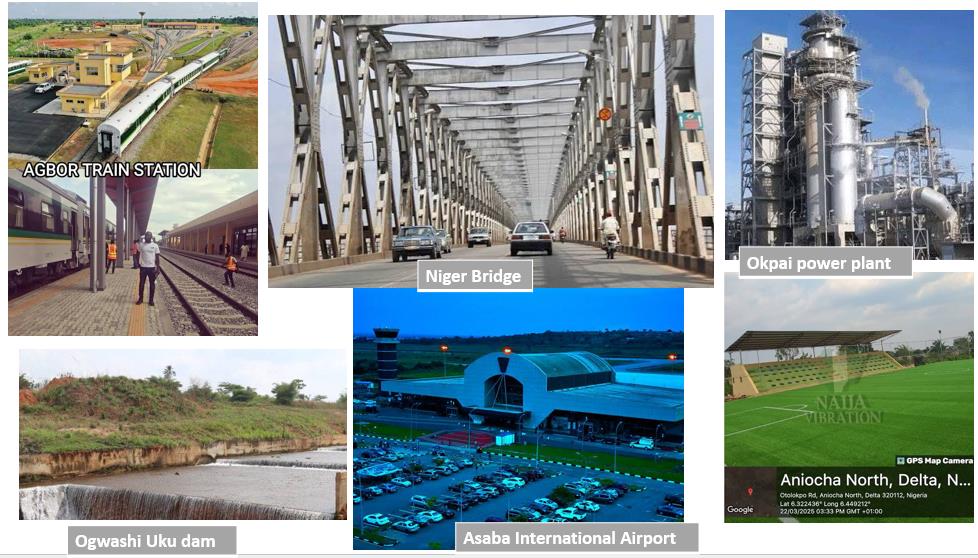
Anioma land hosts some important transport, sports, commercial, and administrative infrastructures. It has witnessed steady infrastructural growth driven by its strategic position as the gateway between the South-East, South-South, and the western corridor of Nigeria. These infrastructures contribute to Anioma’s growing regional influence, its aspiration for statehood, and capacity for self-sustenance.
Some key infrastructures in Anioma land include:
- The Warri–Itakpe Standard Gauge Railway (Agbor Corridor): Anioma lies at a strategic midpoint of the Warri–Itakpe Standard Gauge Railway, Nigeria’s first functioning high-speed standard gauge line. The route passes directly through Agbor, where the Agbor Railway Station (also called Uje–Inland Railway Station) serves as a key passenger hub. This infrastructure has drastically reduced the travel time between Delta, Kogi, FCT–Abuja, and parts of northern Nigeria. It has lowered transportation costs for traders and families. It has also reduced pressure on the Benin–Asaba–Onitsha expressway, and created new commercial opportunities around Agbor and neighbouring communities. The Agbor railway corridor is one of Anioma’s strongest economic assets.
- Owena Earth Dam, Ogwashi Dam, Ukhun-Erah Dam: Anioma land hosts several important dams that contribute to water security, agriculture, and rural development across neighbouring boundary areas that directly serve Anioma communities. The Ogwashi-Uku Dam, the most prominent within Anioma, functions as a major reservoir supplying potable water to Ogwashi Uku and surrounding towns while supporting irrigation schemes that enhance dry-season crop production. To the north of Anioma, the Ukhun-Erah Dam also plays a strategic role in stabilizing water availability for farming, fishing, and household use in communities around the Aniocha and Ika corridors. In addition, Anioma benefits from the large Owena Earth Dam, located along the Delta/Edo/Ondo boundary belt, which feeds into river systems that support downstream settlements in parts of Ika and Ndokwa through improved water flow management and seasonal flood control. Beyond these major dams, Anioma is dotted with smaller community earth dams and reservoirs—especially around Obior, Eziokpor, Eziokwale, Amai, and other agrarian communities—which reduce erosion, support aquaculture, and provide dependable water sources for livestock and household consumption. These dams form a critical backbone for agriculture, rural livelihoods, erosion control, and climate resilience across Anioma land.
- The Asaba Stormwater Drainage System: This stands as one of the most significant environmental intervention projects in Anioma land, addressing decades-long challenges of flooding and erosion in the capital city. Designed as a large, multi-channel network of underground and surface drains, the system captures, redirects, and safely discharges rainwater from major flood-prone areas such as Okpanam, DBS Road, and Jesus Saves Corridor. Its construction has drastically reduced seasonal flooding that once disrupted business activities, damaged properties, and impeded transport within the metropolis. Beyond its engineering value, the drainage system enhances urban livability, supports road durability by preventing waterlogging, and contributes to the long-term environmental resilience of Asaba. It represents a major investment in modern urban planning and remains one of the largest and most efficient stormwater management systems in South-Eastern Nigeria.
- Power and Energy Installations: Anioma hosts important power transmission nodes, including the Steel Complex Substation in Asaba, the Ibusa Transmission Station, and the grid network that supplies electricity to many surrounding communities. Ongoing projects involving independent power providers (IPPs) aim to stabilise electricity distribution in places such as Okpanam, Owa Alero, and Kwale, where commercial and agro-processing activities are expanding. There is the Okpai power plant, and gas flaring fields associated with the Kwale Gas Plant and platforms around Aboh have attracted discussions on harnessing cleaner, community-centered energy solutions.
- Boat jetties: Anioma’s extensive river network along the River Niger and its tributaries has given rise to several important boat jetties that serve as transportation lifelines for riverine communities and coastal parts of Oshimili South, Oshimili North, Ndokwa East, Aniocha South, and parts of Ika South where communities sit along the River Niger or major tributaries. In Oshimili South, the Asaba Marine Jetty—located along the River Niger waterfront, supports passenger movement, local trade, and ferry services connecting Asaba with Onitsha and other riverside settlements. Further south, communities such as Oko Anala, Oko Ogbele, Illah, Akwukwu-Igbo, and Ebu (in Oshimili North) rely on functional community jetties for fishing activities, inter-community movement, and transport of agricultural produce. In Ndokwa East, which is heavily riverine, jetties in towns such as Aboh, Ashaka, Ibrede, Okpai, Abala-Oshimili, and Umuolu remain central to daily mobility because many areas are accessible only by water for part of the year. These jetties improve commerce, link farmers to markets, and provide essential routes for emergency evacuation during seasonal floods. Across Anioma land, these boat jetties continue to strengthen connectivity, support trade, and preserve the region’s historic river-based culture.
- The First Niger Bridge (Onitsha–Asaba Bridge): Completed in 1965, the Onitsha–Asaba Niger Bridge is one of Nigeria’s most important bridges, linking Asaba (Anioma) to Onitsha (Anambra State) and facilitating millions of daily commercial movements. For decades, it served as the primary arterial gateway connecting the South-East to the rest of the country and remains a major logistics point for commerce, transportation, and tourism in Anioma land.
- The Second Niger Bridge: To ease congestion on the first bridge, the Federal Government constructed the Second Niger Bridge, commissioned in 2022. This ultramodern structure runs through the Asaba axis of Anioma land and has decongested traffic drastically, improved holiday travel flows, enhanced inter-state trade, and expanded real estate and business opportunities around Asaba, Okwe, and Oko communities. Together, the two bridges make Anioma the principal gateway into the South-East geopolitical region.
- Asaba International Airport: Another flagship infrastructure is the Asaba International Airport, which connects Anioma to Abuja, Lagos, Port Harcourt, Warri, Kano, and other cities. The airport supports commercial flights, business jets, cargo operations, aviation training activities, hospitality developments, and tourism. Its strategic position at the entrance of the Niger Bridge makes it the most accessible airport for travellers heading into the South-East from the western corridor.
- The Stephen Keshi International Stadium, Asaba: One of the flagship infrastructures in Anioma is the Stephen Keshi International Stadium, a modern sports complex in Asaba named after the legendary Nigerian footballer from the state. The stadium features a world-class athletics track certified for international events, a 22,000-capacity seating bowl, training pitches, indoor sports halls, standard dressing rooms, and facilities for football, athletics, and indoor sports. It has hosted national sports festivals, African athletics championships, and major political events, making it a landmark symbol of Anioma pride and youth development.
- Delta State Capital Territory Infrastructure (Asaba & Environs): Asaba boasts of major infrastructural developments including: Government house complex, state secretariat phases I & II, high court and judicial complex, modern flyovers such as the Koka Flyover & Interchange, expanded road network linking Okpanam, Ibusa, and Okwe. These infrastructures give Anioma the advantage of being a political and administrative hub.
- Markets and Commercial Hubs: Anioma is home to some of the largest urban and semi-urban markets in Delta State such as: Ogbogonogo ultra-modern market (Asaba), main market (Agbor), Ogwashi-Uku market, Kwale main market, Aboh river market. These markets support cross regional trade with Onitsha, Anambra, Edo, and Bayelsa. There are also clusters of manufacturing businesses in Ogwashi-Uku, agro-processing centers in Ika South, cassava and palm-processing cooperatives in Ukwuani and Ndokwa, and artisan clusters producing ceramics and metal crafts. The proximity to the bridgehead in Onitsha further boosts cross-regional commerce.
- Cultural and Tourism Infrastructure: Anioma also boasts several tourism and cultural infrastructures including: The Dennis Osadebey university museum, Mungo Park house (Asaba), Akwa Ocha cultural and textile centres in Ubulu-Uku and Okpanam, palace infrastructures of major Anioma kingdoms (Igbuzor of Ibuzor, Obi of Issele-Uku Palace, Dein of Agbor Palace, Obi of Aboh Palace, Asagba of Asaba, etc.)