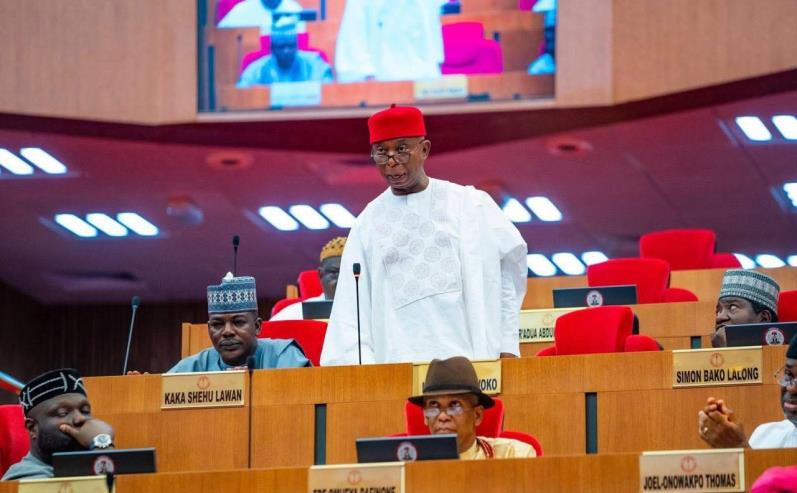
FROM SENATOR NED MUNIR NWOKO — Sponsor, SB. 481 — A Bill for the Creation of Anioma State
The quest for the creation of Anioma State is a legitimate and long-standing aspiration, deeply rooted in history and anchored in the collective will of a distinct people. This is not a novel agitation. It predates Nigeria’s independence, dating back to 1954 when the people of Anioma made a formal request to the colonial government in London for the creation of a West Niger Province. That appeal, which came decades before the eventual formation of most states in Nigeria, was a bold and visionary step by a people determined to chart their own course and shape their destiny within the emerging Nigerian federation. Although that early effort did not yield the desired outcome, it laid a moral and political foundation that remains solid today.
The Anioma people, who inhabit the northern part of present-day Delta State, have sustained this call through generations, driven not by ethnic sentiment or regional rivalry, but by a deeply felt need for administrative autonomy, cultural recognition, and equitable development. The name “Anioma” is an acronym representing Aniocha, Ndokwa, Ika, and Oshimili, four culturally and linguistically connected blocs that share centuries of history, kinship, and socio-political identity. The nine local government areas that make up the Anioma region, Aniocha North, Aniocha South, Oshimili North, Oshimili South, Ika North-East, Ika South, Ndokwa West, Ndokwa East, and Ukwuani, are not merely grouped by geography; they are united by language, values, customs, and aspirations.
The advocacy for Anioma State was championed by respected national figures, notably Chief Dennis Osadebe, one of Nigeria’s first premiers, whose vision for a state that could harness the potential of the Anioma people remains unfinished. Today, that torch has been passed to this generation. As the sponsor of SB. 481, I am merely a custodian of that vision, standing on the shoulders of those who came before and answering the call of those who continue to believe that a state of their own will enable them to contribute more meaningfully to the Nigerian project.
The push for Anioma State is underpinned by several irrefutable facts. First, Anioma is a culturally cohesive and politically mature region. It is not a collection of scattered communities, but a well-defined bloc with shared institutions, traditions, and leadership structures. Secondly, Anioma is economically viable. The region hosts significant oil and gas resources, particularly in Ndokwa West and Ndokwa East, where multinational companies such as Agip and Sterling Global currently operate. These natural resources alone guarantee that the proposed state would not be a financial liability to the federation but rather a strong contributor to the national economy.
In addition to oil and gas, Anioma is blessed with fertile agricultural land capable of producing cassava, yam, rice, maize, and palm produce in commercial quantities. The area is already a key player in Delta State’s agricultural profile and has the capacity to feed itself and contribute to national food security. With dedicated state-level agricultural policies, Anioma could transform into one of Nigeria’s leading food-producing hubs. The human capital base of Anioma is equally impressive. The region has produced some of Nigeria’s most accomplished professionals in law, medicine, education, public administration, and the creative industries. These are men and women who have made immense contributions both within and outside Nigeria and who can be relied upon to help build a well-governed, forward-looking state.
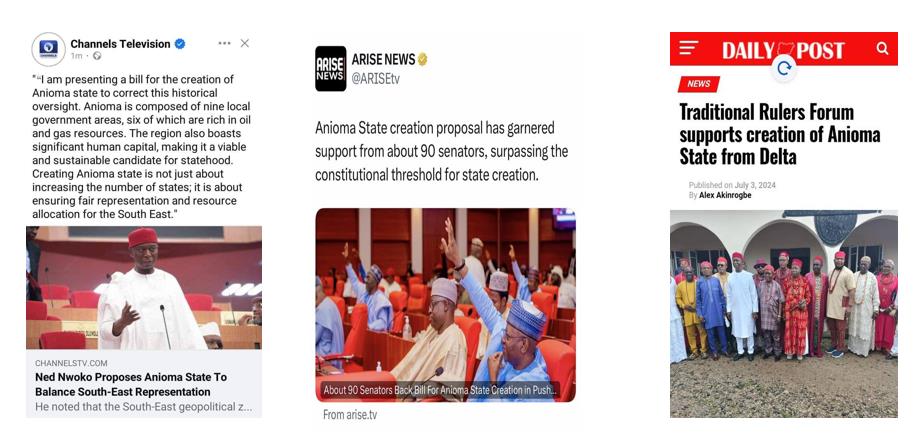
The call for the creation of Anioma State is also strongly supported by traditional institutions and civil society. The stakeholders’ summit held in Asaba on 31st August 2024 reaffirmed the overwhelming consensus among Anioma leaders and citizens on the need for statehood. The summit was attended by traditional rulers, political actors, technocrats, youth groups, and community leaders who spoke with one voice in support of this cause. It is not a partisan movement. It transcends political affiliation and ethnic considerations. It is a people’s demand grounded in history, equity, and the democratic right to self-determination within the boundaries of Nigeria’s Constitution.
Importantly, the creation of Anioma State requires no dismemberment or disruption of existing states. It presents a natural and logical administrative unit, with defined borders and a compact, manageable landmass of approximately 5,930 square kilometers. It has urban centers like Asaba, Ogwashi-Uku, Agbor, and Kwale that already possess the infrastructure necessary for effective state administration. With existing institutions such as the Asaba International Airport, tertiary education centers, healthcare facilities, and road networks, Anioma has a clear head start on the road to sustainable development.
Senate Bill 481, which I have the honour to sponsor, was read for the first time in the chamber on 2nd July 2024. Its purpose is not only to correct a structural imbalance but to fulfill a historical obligation. As lawmakers, we are entrusted with the duty to listen to the people, to correct past oversights, and to make decisions that promote unity, fairness, and development. The creation of Anioma State will deepen national cohesion, ensure fairer representation, and unleash the economic potential of a region that has waited patiently for far too long.
I urge my colleagues in the National Assembly, as well as all patriotic Nigerians, to rise above the politics of convenience and embrace this opportunity to make history. Let us not be remembered as the generation that heard a just call and ignored it. Let us instead be the Senate that responded with wisdom, courage, and justice. In supporting this bill, you are not merely creating a state, you are correcting a historical oversight, empowering a people, and strengthening the foundation of our great nation.
Thank you.